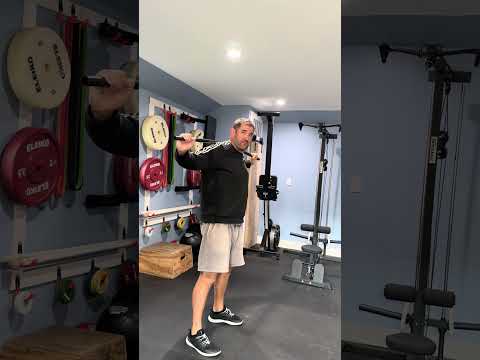
Good morning is one of my go to exercises for improving glute strength and teaching a better hinge pattern.
A lot of people struggle to hinge correctly without rounding the back or shifting pressure too far into the toes. This is one of the simplest ways to teach the hips how to load properly while staying in a strong position.
The bar or PVC starts on the shoulders, not the neck. Elbows slightly up to help lock the upper back in place. Feet about hip width apart with the toes turned slightly out.
To start the movement, hinge at the hips first. Butt goes back, torso tilts forward, and the knees bend slightly. Keep pressure through the middle of the foot and maintain a flat back throughout the movement.
Lower until you feel tension in the hamstrings while still maintaining position. Then stand back up by driving the hips forward.
This can be used:
As a warm up before squatting or pulling
As accessory work for glutes, hamstrings, and low back
To improve bracing and hinging mechanics
Typical use:
Warm up: 1–2 sets of 5–8 reps
Accessory work: 2–4 sets of 6–10 reps
This is one of my favorite exercises for teaching people how to move better under load without overcomplicating things.
Good morning is one of my go to exercises for improving glute strength and teaching a better hinge pattern.
A lot of people struggle to hinge correctly without rounding the back or shifting pressure too far into the toes. This is one of the simplest ways to teach the hips how to load properly while staying in a strong position.
The bar or PVC starts on the shoulders, not the neck. Elbows slightly up to help lock the upper back in place. Feet about hip width apart with the toes turned slightly out.
To start the movement, hinge at the hips first. Butt goes back, torso tilts forward, and the knees bend slightly. Keep pressure through the middle of the foot and maintain a flat back throughout the movement.
Lower until you feel tension in the hamstrings while still maintaining position. Then stand back up by driving the hips forward.
This can be used:
Typical use:
This is one of my favorite exercises for teaching people how to move better under load without overcomplicating things.